 Doodling Can Help Memory, a study published in Applied Cognitive Psychology found (popular science article on same).
This is kind of funny to me as I was often admonished in school for doodling, teachers insisting that I was not paying attention. I made more than one teacher extra irritated by echoing back enormous portions of the lecture they were giving in what I thought was honest proof of my actually paying attention. This admonishment about “not paying attention” also followed on the heels of me tapping, rocking, moving in any way or pretty much doing anything besides sitting completely still–ironically something that will cause me to become utterly unable to pay attention.
The doodle study reminds me of the eye contact study that included key findings such as:
* It is relatively easy to train five year olds to avert their gaze more when answering questions. This increases their ability to answer both verbal and arithmetical questions.
* Children develop the use of gaze aversion as a concentration tool during their fifth year.
* In the laboratory, children averted their gaze less when interviewed across a live video link than when interviewed face to face. However, question difficulty had an enormous impact on the amount that children averted their gaze from the interviewer in both situations. This suggests that children avert their gaze when answering difficult questions to avoid the extra mental effort of monitoring faces, rather than for social reasons, such as embarrassment.
Continue reading “I do doodle. You, too. You do doodle, too.”*
 It’s with very mixed feelings that I read articles like
 The term “autism awareness” at this point makes me cringe like an abused dog expecting to be slapped. Too often “autism awareness” translates directly to, “a bunch of harsh, dehumanizing marketing telling the world that you are worthless trash.” So I nearly didn’t click on the link called
 This morning I posted about
 The Community Adult Autism Partnership Program (CAAPP), in West Chester, Massachusetts
 In
 Self-advocacy involves 1) knowing your needs, 2) communicating your needs, 3) enforcing your needs. I’m highly skilled at the first item. As long people are accommodating of my communication style, I’m not too shabby at the second item either. The third item however can be a big problem because it involves barriers set by people, agencies, and bureaucracy. These barriers can be especially difficult to surmount when the people or agencies have the power to revoke services necessary for survival or quality of life.
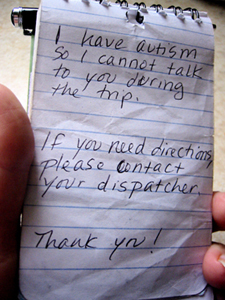 One of the disclosure issues that appeared in a thread over the weekend was the question of who needs to know about a diagnosis of ASD, and when disclosure will make a situation better or worse. Unlike the role of disclosure in discrimination protection in the U.S., there are no specific rules about who to disclose to that are applicable to all people. I’ll list my rules, but with the disclaimer they may not be good rules for everyone to follow.
 One of the focuses of the
 Some ideas about disclosure were brought up in various threads here over the weekend. Disclosure, telling someone you’ve been diagnosed with an ASD, can in some situations be a literal life saver–and may in other situations create extra problems. Even taken just from the self-advocacy side of autism issues, disclosure is too big and too important to address suitably in a single post, so I’m going to do a short series on disclosure throughout the week. First, disclosure in relation to discrimination protection in the U.S.