USA Finally on Board with UN CRPD

a dramatically lit marble. the marble is translucent blue with solid tan outlines of the continentsAfter three years, the USA has finally signed onto the International Convention on the Rights of Persons with Disabilities (CRPD). The Convention was created in full participation with the international disabilities community on the principle of Nothing About Us Without Us, and reflects the critical shift in paradigm toward social, affirmative, and equitable perspectives on the essential human rights of people with disabilities.

Obama announced earlier in the week that he would be signing the convention today, Friday 24 July, 2009.

This signing is coming on the week of the 19th anniversary of the ADA.

Here’s linkage back to a long-ago post of mine on the CRPD, which includes, perhaps more importantly, some links to self-advocacy manuals based on the treaty from Harvard Project on Disability.

ADA B-Day, an Ambiguous Affair

This week is the 19th anniversary of the Americans with Disabilities Act. I’ve blogged about the ADA a fair amount, some positive, some critical, and plenty just in passing or reference.

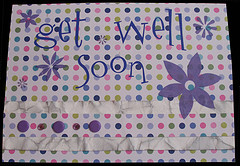
I’m not the only person who has mixed feelings about this legislation which has been both a powerful tool for equality and a nasty disappointment for people seeking justice. Lower Hudson Journal News contributor Robert Cole asks whether a get well card would be more appropriate for the ADA than a birthday card. Cole sites little change in employment rates, continued lack of access, and continued lack of community inclusion as deep issues.

Obviously there are issues with the ADA itself that need to be rectified, but do those issues account solely for Cole’s observations? What role might other factors such as lack of program coordination, conflicting policies, and program disincentives (National Disability Policy: A Progress Report document for more ideas) play in the bigger picture? What about situations where the government is refusing to work on the infrastructure necessary for the ADA to be fully realized? What other complex factors, like the intricacies of transportation, that often aren’t thought about? What about the sort of discrimination few see because it is culturally sanctioned?

As Cole states, we have to do better.

But where is the leverage for doing better? Is it in the ADA itself, or elsewhere?

What do you think, should the ADA get the birthday card, the get well card, or both?

Strengths and Deficits, Another Sort of Academic Bias

Between my posting Culturally Sanctioned Stigma and Academic Bias and now, Tyler Cowen’s excellent article “Autism as Academic Paradigm” has unfortunately been moved to a payed subscriber only area of the Chronicle. From my notes though I still have the quote,

In “special needs” education, there is plenty of effort to teach the skills of the non-autistic to the autistic, but in the regular classroom we are often doing the opposite. I view higher (and lower) education as teaching people to be more autistic in many of their basic cognitive skills…

This filter for looking at the types of skills that are taught in public schools is particularly interesting in light of recent research regarding autistic problem solving skills.

Also of import is the role of point of view and bias in how the education of autistic and non-autistic students is framed. Teaching non-autistic students (the majority) the skills of the minority is considered building strengths. Teaching autistic students (the minority) the skills of the majority is considered remediating deficits.

This relates directly back to Norman Kunc’s model of perspectives on disability (see the line item on deficiency and remediation).

The interconnections between broader civil rights issues and seemingly unrelated topics like education and science are subtle, but strong. Civil rights issues color the lens through which people are viewed, framed, and treated in all aspects of life.

Science and the Dark Ages

Yesterday, in a meeting of autism researchers I attended, a researcher described people with Retts as having “no souls.” That Retts “takes the souls” of girls. The researcher said this without malice; in fact, I had the strong sense that he felt this description was in some way compassionate. When it was recommended to him by another researcher who does a lot of work directly in collaboration with the disability community (not me though I was sure thinking it) that he might want to meet some real girls with Retts to see that they do, in fact, have souls, he related how meeting the father of someone with Retts is what inspired him in his mission to return these girls’ souls.

Relating this to a friend later, my friend asked, “did he really mean that literally, like a religious thing?”

I’ve no way to know for sure of course, but my suspicion is that it wasn’t a religious thing; that the word “soul” was more likely being used as a synonym for “personhood” or “humanity” or “that which makes a person a person.”

The mix of souls with science harkens back to the ages before a separation between the mystical and the scientific. But there’s a more recent dark ages involving lack of understanding, inclusion, or respect for people with disabilities in discourse about their own lives. Of viewing people with disabilities as broken things, and not as human beings.

While the Renaissance may be here, we’re still not fully out of those dark ages, or else the term “soulless” would be as abhorrent when applied to someone with Retts as it currently is applied to someone from a minority racial or ethnic background.

Increased direct involvement of the disability community in research is one way to start lighting this darkness; however, it’s hard to motivate people to become involved when they are labeled in disparaging ways like “soulless.” I know I certainly wouldn’t participate in any sort of research–not as a participant and not as a colleague–from someone who feels that Retts “steals souls.” Something else, or more, or just different may be required to bootstrap some segments of the research community into a more modern paradigm.

AAC in the News

ABC News did a little feature on the speech device I’ve been using a lot lately (my initial report and quick review). I feel a little awkward going on about this specific product (see Kristina’s post on blogging and product placement), but I do feel that the broader themes of accessibility, bringing AAC to the mainstream, and the value of AAC that is developed with the input of the end users are all items that make P2G writings go beyond plugging a product. These broader themes may be why ABC News felt a feature was in order.

So ABC News–here is the video (also embedded, and, warning, I was only able to get the video to play from the ABC News site in IE). Here is the full transcript of the video.

For the video-lovers, there are more videos of P2G on youtube.

It’s good to see AAC hitting the mainstream news more and more. The more ubiquitous AAC becomes in both the mainstream news and in the day-to-day lives of people–the more the public is exposed to AAC–the more that fear and stigma on the part of the public will erode. It’ll be a great day when AAC becomes as ordinary to people’s sensibilities as eyeglasses.

What Are You? The Wacky World of Funny Accents

There’s a farmer’s market down the street from me. Rainier cherries were on sale for $2.47 a pound–an irresistible opportunity.

There was no get-in-get-out for me this time–before I’d even gotten a bag for collecting my cherries, I was confronted by crescents of fresh cantaloupe, “have some fresh cantaloupe, have a sample, please,” a voice, connection. Say thank you– “Yes, thank you.” Good grief, that melon is good! “Melon is very good.”

“Oooo, what are you?” the lady asked me. “You have such an accent! I’m Russian.”

This is kind of a funny moment. Do I say, “Oh, I am apraxic!” Or “I am autistic!” Do I say, “I am Italian, but my ‘accent’ is just a speech problem?” What are you? Always an interesting question.

After a lot of thinking about how much educating I want to do right that moment (none, all I really wanted was to plop those ripe, juicy cherries into my mouth) I answered, “I have trouble speaking.” I smiled huge, laughed a little, so that she knows I do not take offense. It’s a sequence of steps I’ve learned, practiced, repeat a lot. I have a few versions of the script.

I met recently with a lady with ALS who is interested in one of the speech devices I use. I handed her my device with my “greetings” page open for her to play with and she pressed on “I can hear you just fine.” She started laughing. She understood exactly why I have that message. When I’m at a disability-related event instead of a fruit stand, or interacting with someone who has connections to the Deaf community, I get signed at just as often as spoken to.

This is an interesting example of how context and experience plays out in people’s assumptions: my “accent” is assumed as coming from growing up as a non-English speaker to some, and assumed to be because I’m deaf to others, depending on what sort of culture one is attuned to.

I long ago got over the childhood torment I’d been put through over my “funny accent.” It’s just a fact of my life, and I have learned how both accept it and how to help others to understand and accept it also and move past it. Learning how to effectively dispel various not-quite-right reactions to atypical communication is a very valuable life skill to me and to the people I interact with.

Music Interests (and Questions) Coast to Coast

a bright blue exterior door with a bright yellow, blue, and pink painted cello propped up next to itOn the extreme east coast of the U.S. in Massachusetts, a young autistic girl finds joy in the classical violin. On the extreme west coast of the U.S. in Oregon, a young autistic boy finds joy in indie pop. But the two stories about autistic kids with musical loves otherwise possess a nearly interchangeable story.

On one hand these stories are about kids being kids, having interests, gaining self-esteem and self-expression, falling into love with creativity. Stuff that one hopes is part of the life of kids, any kids. And yes, the activities these kids are doing would make decent local news stories if the kids weren’t autistic too.

But on the other hand, these stories do fall into the boring autism news stories 101 story of AMAZING ACCOMPLISHMENTS!!!! (as well as contain some fairly barf-worthy stigmatizing language).

And, beneath both those surfaces, why should it come as a surprise that autistic kids, like any other kids, benefit hugely from doing stuff they like and are good at? This isn’t a kid question (ya’ll know I typically make it policy not to blog about children, and this post is not about children but about some more universal ideas), because the same question can be asked why should it come as a surprise that autistic adults, like any adults, benefit hugely from doing stuff they like and are good at, and participating on their own preferred terms in the community?

No matter what the age, diagnosis, lack of diagnosis, or what all else, we are people, and (surprisingly? er…) we tend to benefit hugely from being treated as such.

Different Country, Same Issues (Sort Of)

This quote (source),

“For too long people with autism have been misunderstood and discriminated against by a counter-productive system that often lets people reach crisis point before they get the help that they need.”

May have come from someone in the UK (Mark Lever, chief executive of the National Autistic Society, to be exact), but it could have been said by someone in the US without any loss of relevance. Here too, in the US too, “For too long people with autism have been misunderstood and discriminated against by a counter-productive system that often lets people reach crisis point before they get the help that they need.”

The big difference however is that the quote is being made in the context of a government audit that found that providing non-crisis services for individuals on the spectrum could save the country millions. The quote continues,

“There is a huge shortfall in social care funding which urgently needs to be addressed and it’s absolutely crucial that reform is not at the expense of those who may need a lifetime of support. People with lifelong conditions, such as autism, may be less able to save and pay for their social care.

“If the Government are serious about giving people with autism the same rights and opportunities as everyone else we must have a system that is both fair and affordable for all.”

As autism policy in the US continues to fixate primarily around a narrow range of interventions for small children, separate itself from larger disability issues (including lessons already learned), and ignore the concept of long term supports and services in the national agenda, the future for most of us in the states is not seeming so shiny. What is needed to shift priorities into the bigger picture?

CLASS vs. CCA

While the Community Choice Act (CCA) remains ignored, the Community Living Assistance Services and Supports (CLASS) Act has been marked up for inclusion in health care reform. The CLASS Act being marked up isn’t in and of itself isn’t bad, but the contrast–and perhaps interconnectedness–with the CCA being ignored is problematic.

This blog post contains a press release from ADAPT criticizing the support of the CLASS with no mention to the CCA.

Originally the two acts were supposed to be related. CLASS essentially enables individuals who currently have good employment (middle class and above) to save money out of their pay checks for long term supports later on. CCA essentially ends the institutional bias of medicaid so that when those individuals need the supports–as well as (more importantly to the topic of this blog here) low income or non-working individuals who currently need the supports–will be able to get those supports from the community instead of being forced into a nursing home or institution. This doesn’t just make financial and ethical sense, it’s literally the law. The comments are at least as interesting as the original post. Especially worth reading is the one about benefits bias from Mark Romoser (who also always has an interesting comment worth reading here).

This blog post contains a brief summary of current events with the CLASS act. What’s interesting about this post isn’t the post itself as much as the second comment about the costs of long term care–and the concept that what people would pay out for the CLASS Act might not actually cover their true long term care costs.

Yet more pieces of the bigger picture.

Monday Autism News Potpourri

a bowl of random assorted items; recognizable: rubber band ball, spiderman head, large white flower, small white flower, shells, pine coneBig News — Last week the senate passed the Matthew Shepard act anti-hate crimes legislation. Many thanks to all of you who contacted your congress critters about that! The bill still has a way to go however, as the article notes. It’s not a done deal, as, among other things, it is being amended to a defense bill that may not pass (U.S. policy making–not always making much semantic sense).

Little Followup — There’s a New York Magazine interview with Hugh Dancy who plays Adam in the film Adam. To the reporter, yes, it is crass to insinuate that someone is less lovable if they are less physically attractive since it doesn’t “make up for” being autistic. Otherwise, this is just a little followup blurb.

Little News — The new Assistant Secretary of Labor for Disability Employment Policy Kathleen Martinez has been confirmed. She comes from a strong disability background, including being disabled herself. Nothing about us without us.

Big Followup — I did a main post on Specialisterne earlier this year. Specialisterne (“the specialists”) is a Danish company that believes in the value of autistic interest and skills in the workplace, and promotes strengths-based, supported employment. One of the (many) cool things about Specialisterne is that it doesn’t automatically assume that a person on the spectrum is only suited for cleaning toilets or other sterotyped menial labor. Instead the company finds skilled technical work for people with a love for detail, and yes, specialization.

Felt that bore some repeating because it’s a thriving, successful business model that is now expanding into other countries. According to the BBC, Specialisterne is setting up a new branch in Scotland. Most excellent. Here is some video coverage as well. Perhaps someday there will be a branch in my own town? Perhaps they’d enjoy employing me? Heh.